Skip to content
AI Feasibility Platform · Government

Three modules that read a feasibility study, judge it, and write a new one from scratch

How HexaFlow built an AI feasibility platform for Dubai Municipality. Three modules: one reads a feasibility and fills the whole Excel model, one benchmarks it against world standards and returns a gap analysis, and one generates an entirely new professional feasibility from historical data.

Three modules, one platform
Figures extractedExcel model filledFormulas applied
MetUnevidencedFalls shortTo close

A new feasibility study from local historical data and current market conditions.

Big Four consulting standardsDraft for reviewer sign-off
Client
Dubai Municipality
Industry
Government
Region
UAE
Year
2026
The problem

A feasibility assessment is four jobs. Only three were done in-house.

Inside a municipal authority, every proposal has to be read, turned into the figures a decision rests on, judged against international standards — and sometimes written from nothing at all.

  1. 01

    Reading

    Feasibility assessment inside a municipal authority means working through large volumes of dense technical and regulatory documentation, where the material that determines a decision is buried across hundreds of pages — and arrives in whatever format the submitting consultancy chose to use.

  2. 02

    Transcribing

    The work does not stop at reading. Every assessment produces downstream artefacts: financial sheets, standardised forms, calculation tables. These were being filled by hand, transcribing figures out of one document and into another, which is slow and exactly the kind of task where transcription errors quietly enter the record.

  3. 03

    Benchmarking

    Benchmarking was harder still. Judging a proposal against ISO, WHO and other international standards requires knowing which clauses apply and finding the corresponding evidence in the submission — expert work that varied depending on who performed it.

  4. 04

    Commissioning

    And commissioning a feasibility from scratch meant going outside: a professional study is a six-to-twelve-week external consultancy engagement, even when the authority already holds the historical data the study would be built from.

Not document automation. A feasibility platform that does the analyst's entire job — and then does the job the analyst could never do at all.

01 Module one

Analyse and populate.

The analyst's reading and transcribing, done from the source.

Ingests any feasibility study, external or internal, parsing inconsistent structures into a common representation rather than requiring a fixed template. Every figure is extracted and the complete Excel model is filled — sheets, formulas and calculation chains computed from the source document rather than retyped from it.

  • Any format in. AI extraction from third-party feasibility studies and internal feasibility documents, handling varied formats and structures.
  • Every form and sheet out. Automated population of the forms and sheets each feasibility requires, driven by the extracted data.
  • Calculated, not retyped. Financial sheet completion with formulas applied, so calculations derive from the source rather than manual transcription.
  • The critical sections, summarised. Automated summarisation of critical sections within large regulatory and technical filings.
feasibility-study_final.pdf
Numbered sections, figures in tables
feasibility-model.xlsx Calculated
B3fx48,200,000
Extracted · Table 4.2 · Capital expenditure
ABC
1ItemValueSource
2
3
4
5
6
7

Illustrative sample. Click any cell: an extracted value names the passage it came from; everything else is a formula.

Third-party feasibility ingested and parsedExtracted structure and summarised critical sectionsFinancial sheet populated with formulas applied
02 Module two

Benchmark and gap-analyse.

Expert judgement, applied the same way every time.

Scores the submission against ISO, WHO and other international frameworks, and returns a full gap analysis: what is met, what is unevidenced, what falls short, and what it would take to close each gap. The same judgement applied the same way, regardless of who is reviewing.

  • Against the frameworks that matter. Feasibility analysis benchmarked against international standards including ISO, WHO and other recognised frameworks.
  • A full gap analysis. Full gap analysis per submission: requirements met, requirements unevidenced, and what closing each gap would take.
MetUnevidencedFalls shortTo close
Gap analysis · sample submission
Mixed-use development
3 frameworks
ISO 31000Risk management
  • Where it falls short

    Risk review happens once, at approval. Nothing covers construction or operation.

    To close

    Define a review cycle through construction and operation, and who carries it out.

ISO 14001Environmental management
WHO air qualitySite exposure

Illustrative sample, paraphrased — open a requirement to see its evidence and what closing the gap would take.

Standards benchmark and gap analysis against ISO and WHO frameworks
03 Module three

Generate from scratch.

The job the analyst could never do at all.

Produces an entirely new professional feasibility study from the authority's own local historical data and current market conditions, written to Big Four consulting standards. Modules 01 and 02 make an existing process faster; this one removes the need to commission the study externally at all.

  • A whole study, in-house. Generation of an entirely new professional feasibility study from local historical data and current market conditions, to Big Four consulting standards.
  • One structure for every study. Standardised feasibility study generation, removing structural variance between assessments.
Before

A six-to-twelve-week external consultancy engagement — even when the authority already held the historical data the study would be built from.

With Module 03

Generated in-house from that data and current market conditions, as a draft for the authority's own reviewer to sign off.

Feasibility study · sample
Mixed-use development
Draft · for review
  1. 01
    Executive summary

    The case for the development, the headline financials and the recommendation, on one page.

    Historical dataMarket conditionsStructured model
  2. 02
    Market assessment

    Demand and pricing for comparable space, drawn from current market conditions.

    Market conditions
  3. 03
    Evidence from comparable projects

    How the authority’s own comparable projects performed, from its local historical data.

    Historical data
  4. 04
    Financial analysis

    Costs, cash flows and returns — sheets populated and formulas applied, as in Module 01.

    Structured modelHistorical dataMarket conditions
  5. 05
    Standards and risk

    The proposal measured against ISO, WHO and other frameworks, with any gap stated.

    ISO · WHO benchmark
  6. 06
    Recommendation

    A recommendation written for the reviewer to accept, amend or reject.

    Structured model
0 of 6 sections reviewed

Illustrative sample. Tick each section as reviewed — sign-off stays locked until every one is.

Feasibility study generated from historical data
Across all three

Structured for review, not blind acceptance.

Every output is built for a reviewer to interrogate — the extracted values trace back to their source, the benchmark shows its evidence, and the generated study reads as a draft to be signed off rather than an answer to be trusted.

01

Values trace to their source

Every extracted figure names the passage it came from — select any input cell in the Module 01 demo and the source lights up.

02

The benchmark shows its evidence

Each requirement carries what the submission shows, what it doesn't, and what would close the gap.

03

A generated study is a draft

It is written for a reviewer to accept, amend or reject — and signed off by a person, not by the platform.

How it's built

Two ways in. One feasibility model in the middle.

Two entry points feed one structured feasibility model. Submitted documents are parsed, chunked and passed through LLM extraction; historical data and current market conditions feed the generation path directly. From that shared model the platform drives form and sheet population, formula calculation, standards benchmarking with gap analysis, and — where no submission exists — a complete generated study for reviewer sign-off.

In
Third-party + internal documents
Local historical data + market conditions
Read
Parsing & chunking
LLM extraction
Model
Structured feasibility model
Out
Form & sheet population
Formula calculation
ISO / WHO benchmarking & gap analysis
Generated study

Two ways in, one model in the middle — so everything downstream works the same whichever way a feasibility arrived.

Built with
AI/LLMsPythonFastAPIReactCloud Infrastructure
Outcome

What changed.

Extraction from both external consultancy submissions and internal documents

Forms and financial sheets populated and calculated automatically from source

Transcription errors removed from the calculation chain

Feasibilities benchmarked consistently against ISO, WHO and other world standards, with a gap analysis per submission

A complete professional feasibility generated in-house from historical data, without commissioning an external consultancy

Standardised reporting structure across all submissions

Delivered for a government authority

Next

Related work.

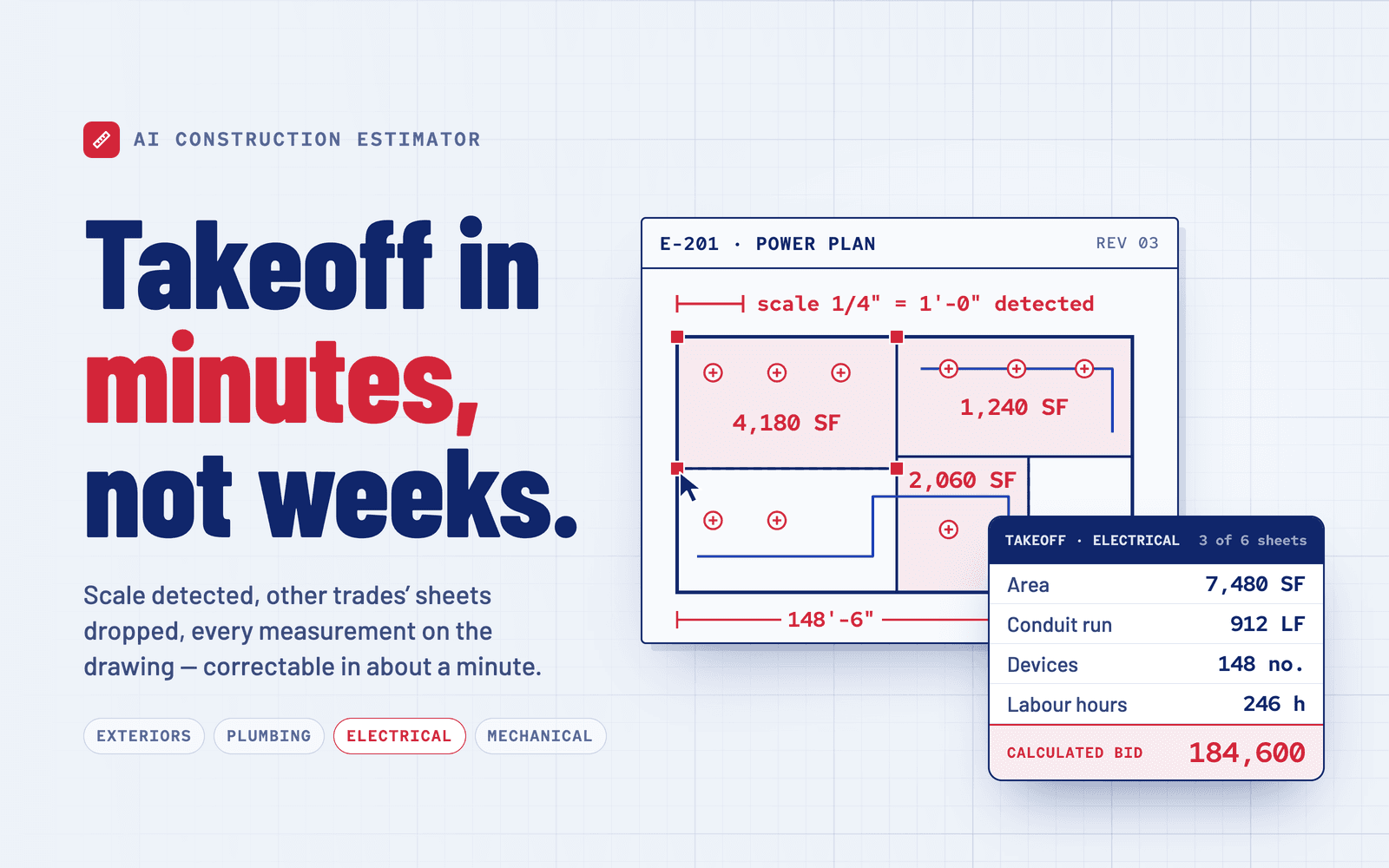
AI Construction Estimator — Construction takeoff and bidding from architectural PDFs, in minutes
Flagship

AI Construction Estimator

Multi-client programmeConstructionUSA

Construction takeoff and bidding from architectural PDFs, in minutes

Reads architectural PDFs, detects the scale on its own, measures only the trade you work in, and returns quantities, labour hours and a bid — then pushes the work into your CRM.

Computer VisionDocument AIDeep Learning
Read case study
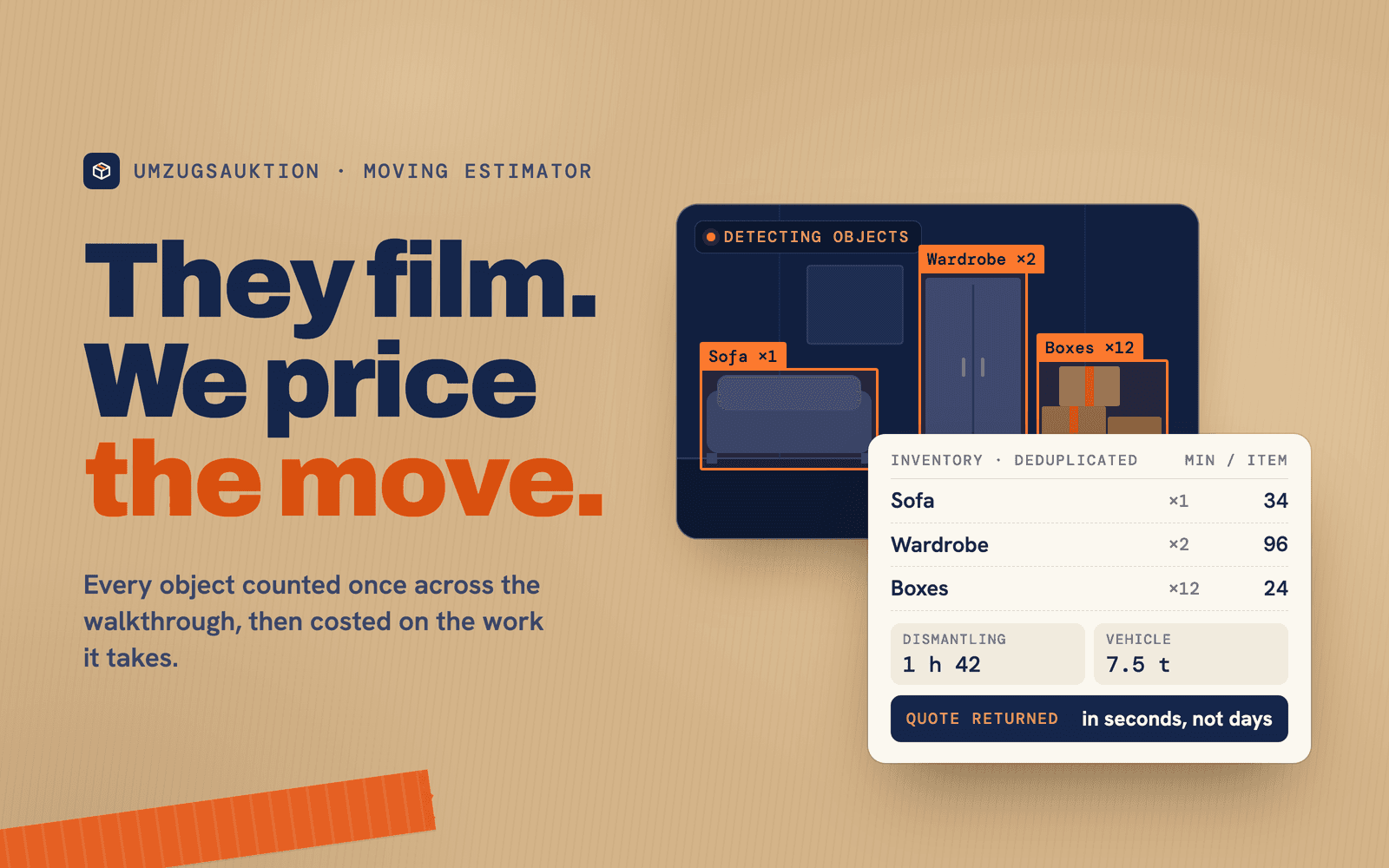
Moving Estimator — A walkthrough video in, a removals quote in seconds
Flagship

Moving Estimator

Umzugsauktion GmbH & Co. KGLogisticsGermany

A walkthrough video in, a removals quote in seconds

The customer films their own home. Computer vision identifies and counts every object, estimates dismantling, handling and transport time, and returns a priced quote.

Computer VisionObject DetectionDeep Learning
Read case study
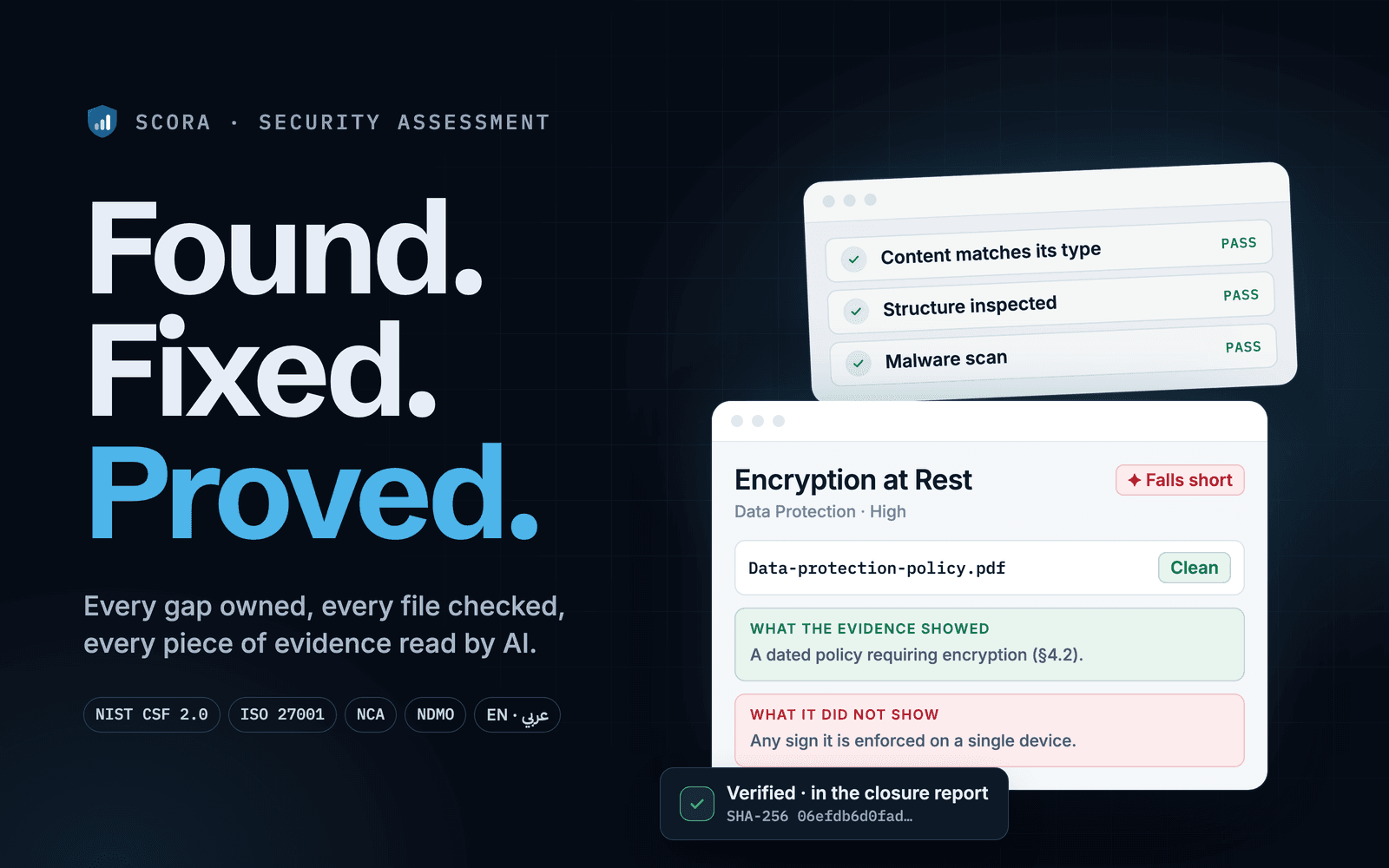
SCORA — Security assessments that end in proof, not a PDF
Flagship

SCORA

SCORAEnterpriseGlobal

Security assessments that end in proof, not a PDF

A security assessment and remediation platform: nine frameworks, every gap routed to an owner, evidence checked and read by AI, and an auditor-ready closure record — in English and Arabic.

Next.jsTypeScriptPostgreSQL
Read case studySee SCORA live