Voice AI Agent Programme
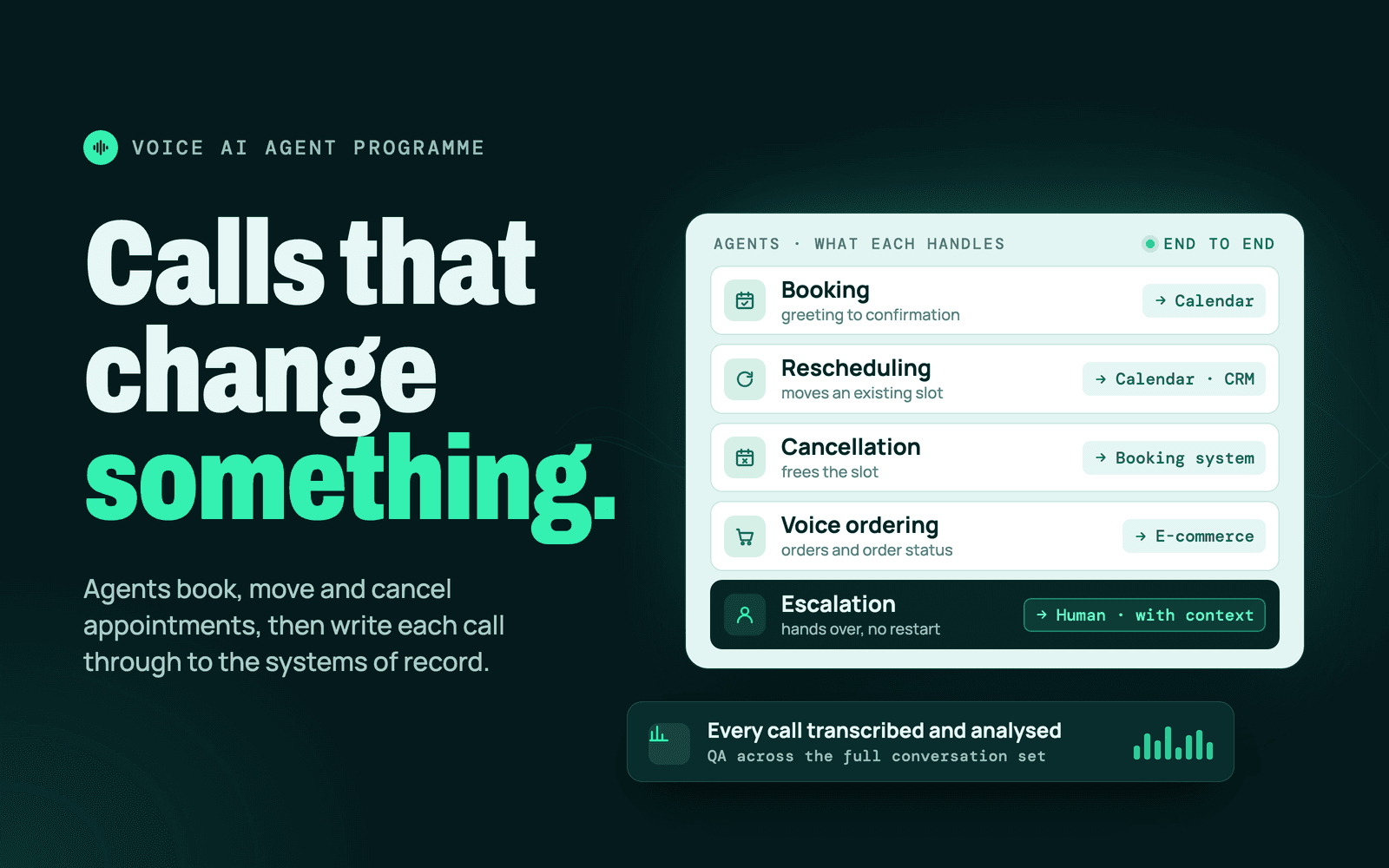
Voice agents for appointment booking, rescheduling and cancellation
Natural-sounding voice agents that handle transactional calls end to end, with call-centre analytics behind them.
An AI agent calls every customer after service and gathers the review on the call itself. Every conversation is then analysed automatically and clustered into a picture of what is happening per department, per individual and across the whole organisation.
Not a survey. A conversation with every single customer — and an executive picture built out of all of them, assembled without a member of staff making a call or reading a transcript.
Feedback at its most accurate. Outcall calls here.
Least accurate — and when a human team gets round to it.
Almost nobody responds to a feedback email. Businesses that depend on their public rating end up hearing from two groups only — the delighted and the furious — and learn nothing from the large silent middle where most of the churn actually hides.
Chasing reviews manually does not scale either. Asking staff to phone every customer costs hours nobody has, and the call quality varies with whoever happens to make it.
There is also a timing problem. Feedback is most accurate within a day of the service and least accurate a fortnight later, which is exactly when a human team gets round to it.
And even where feedback is collected, it usually stops at a score. Nobody has the hours to read hundreds of conversations and work out which department, which shift or which individual the pattern actually points to.
The agent places its call shortly after the appointment ends, job completes or order ships — reading the trigger straight from the CRM or booking system. Everyone is called, not only the ones who would have opened an email.
Rather than reading a rigid survey script, the agent asks open questions, listens, and follows up on what the customer actually said. The feedback is captured inside the conversation — nothing is emailed afterwards and nothing is left for the customer to complete later.
Live feedback call with the review gathered in conversation. Sample calls.
Each completed call is processed and scored by the system itself. No coordinator listens back, no one transcribes, and nothing is manually tagged — the analysis runs across the entire call corpus rather than a sampled few.
Each theme filed to a department, and to a person if named.
Conversations group into themes — what is working, what is failing, and where — and the results resolve by department, by individual staff member and across the whole organisation. Leadership stops guessing which part of the operation has a problem.
Conversations clustered into themes automatically, and resolved by department and by individual. Sample themes and staff.
A completed-service event in the CRM triggers the dialler. The agent runs a speech pipeline with an LLM dialogue layer that gathers the review inside the call. Every completed conversation is then scored, clustered into themes, and attributed to a department and an individual before surfacing on the executive reporting layer.
Every customer called, not just the ones who open email
The review gathered on the call itself, with nothing left for the customer to complete later
Every conversation analysed automatically — no staff member listens back, transcribes or tags
Recurring themes visible across hundreds of calls rather than sitting unread
Results resolved per department, per individual and across the whole organisation

Voice agents for appointment booking, rescheduling and cancellation
Natural-sounding voice agents that handle transactional calls end to end, with call-centre analytics behind them.

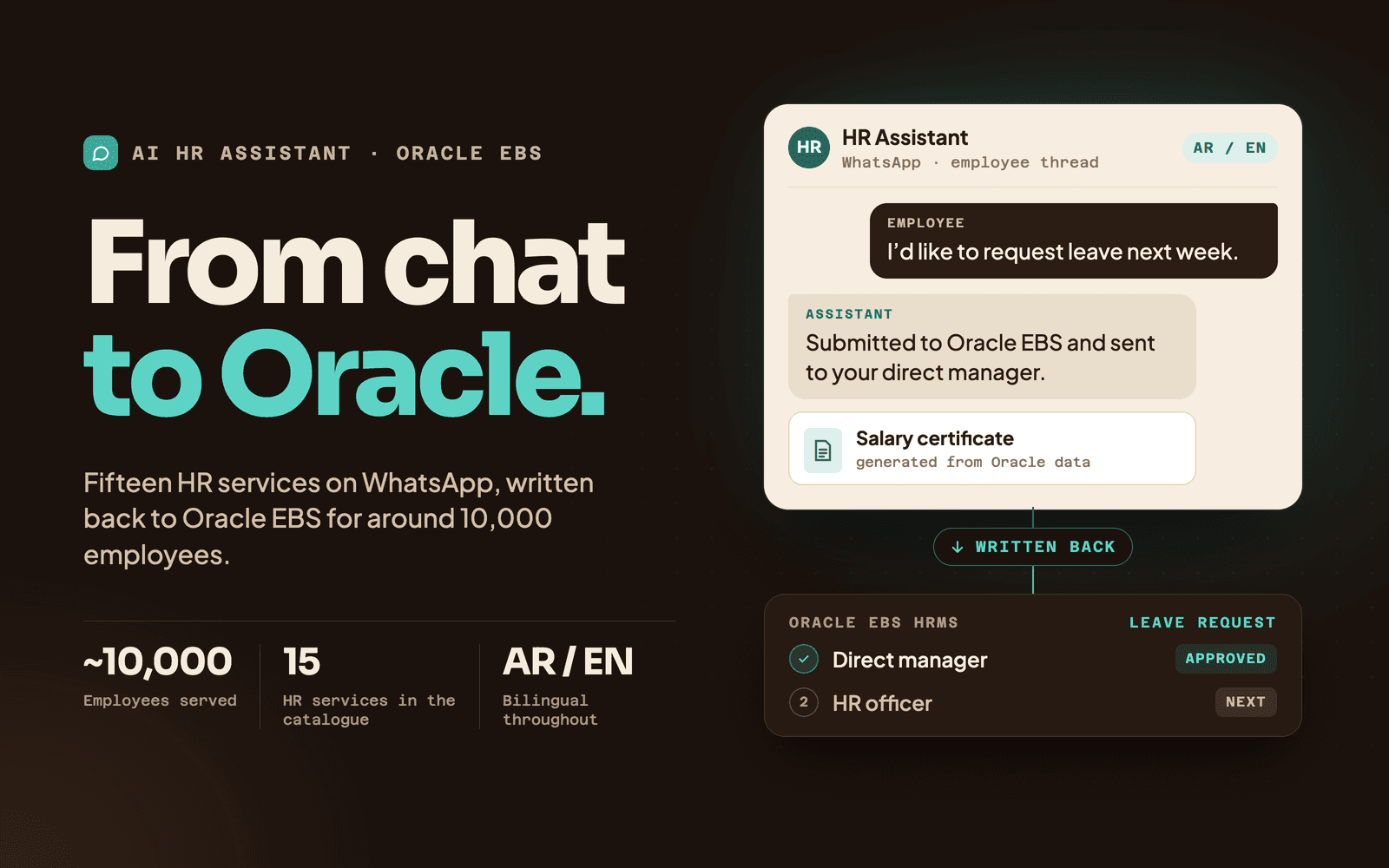
Fifteen HR services, answered on WhatsApp, written back to Oracle EBS
A bilingual AI assistant that turns Oracle EBS HRMS into a conversation — leave, certificates, attendance, approvals — for around 10,000 employees, hosted inside the Kingdom.

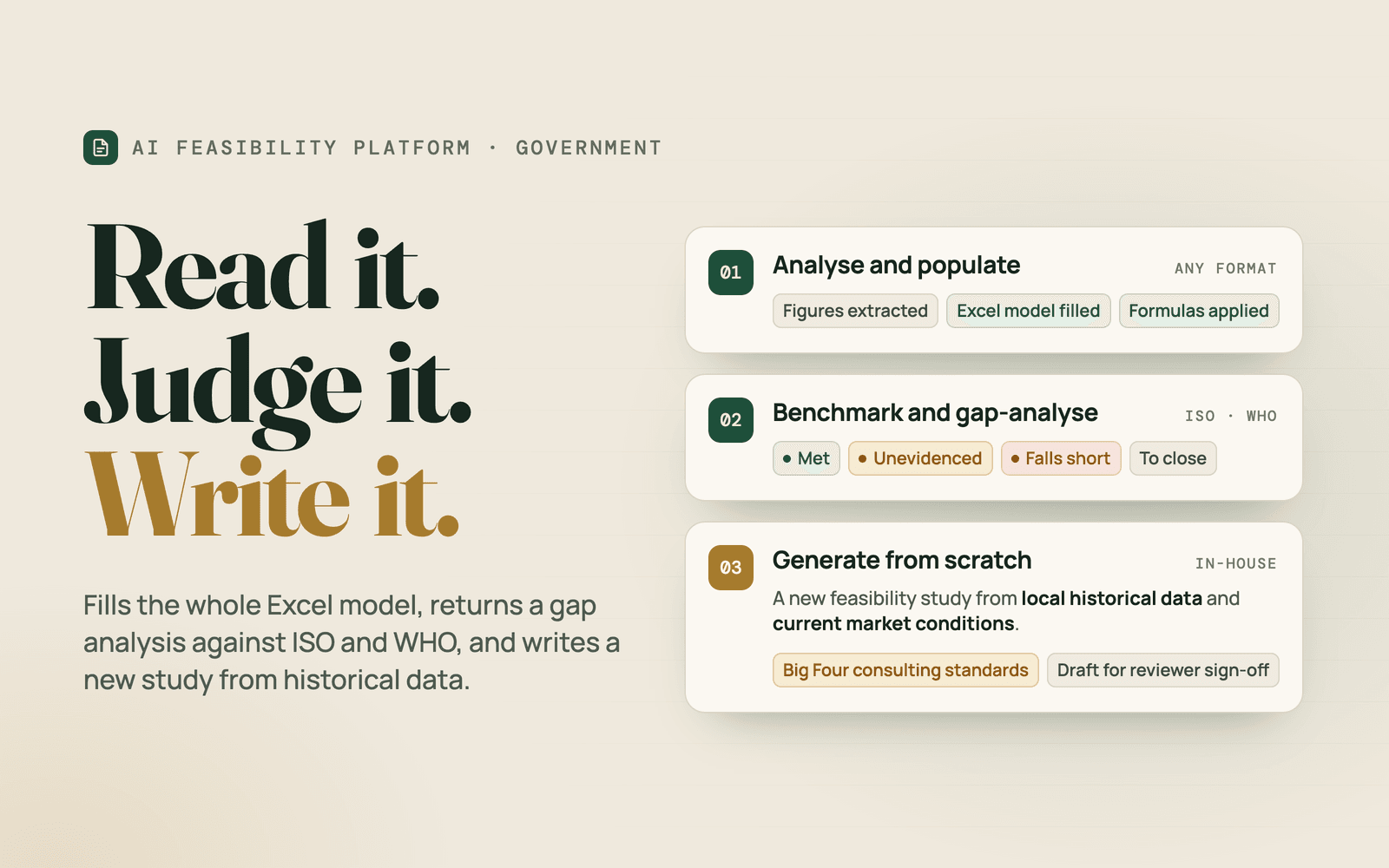
Three modules that read a feasibility study, judge it, and write a new one from scratch
Three modules: one reads a feasibility and fills the whole Excel model, one benchmarks it against world standards and returns a gap analysis, and one generates an entirely new professional feasibility from historical data.